Most memory manufacturers treat 6400MT/s as the gold standard for gaming DDR5, but ADATA’s XPG LANCER RGB DDR5-6000 64GB kit flips that script. In systems paired with AMD’s Ryzen 7 9800X3D, the 6000MT/s configuration delivers 99% of the frame-rate gains of faster kits—while costing significantly less. The reason? AMD’s 3D V-Cache architecture thrives on tight timings and a 1:1 memory clock ratio, not just raw speed.
With CL30 timings and Hynix A-die chips, the LANCER RGB achieves this balance without sacrificing stability. Unlike DDR4, where overclocking often required manual voltage tweaks or aggressive BIOS settings, DDR5’s EXPO profiles handle the optimization automatically. Enable the profile in BIOS, and the system locks into a configuration already tuned for Ryzen 7 9800X3D’s infinite memory controller—no further adjustments needed.
The kit’s dual-rank design (two 32GB modules) ensures compatibility with both AM5 and Intel platforms, though its true strength lies in AMD setups. Testing on an RTX 4080-powered workstation with a 1350W PSU revealed that the 6000MT/s kit matched 6400MT/s rivals in 1080p gaming, with differences so minor they vanished in real-world play. Even in CPU-heavy titles like Star Citizen, the gap was under 0.5%.
Where 6000MT/s Beats 6400MT/s
The real advantage emerges in stability and overclocking headroom. While 6400MT/s kits often require higher voltages to maintain tight timings, the LANCER RGB’s 1.40V profile stays cool under load. Push it to 7400MT/s with minimal voltage increases, and it outperforms many 6400MT/s kits in synthetic benchmarks—a feat impossible with lower-bin chips.
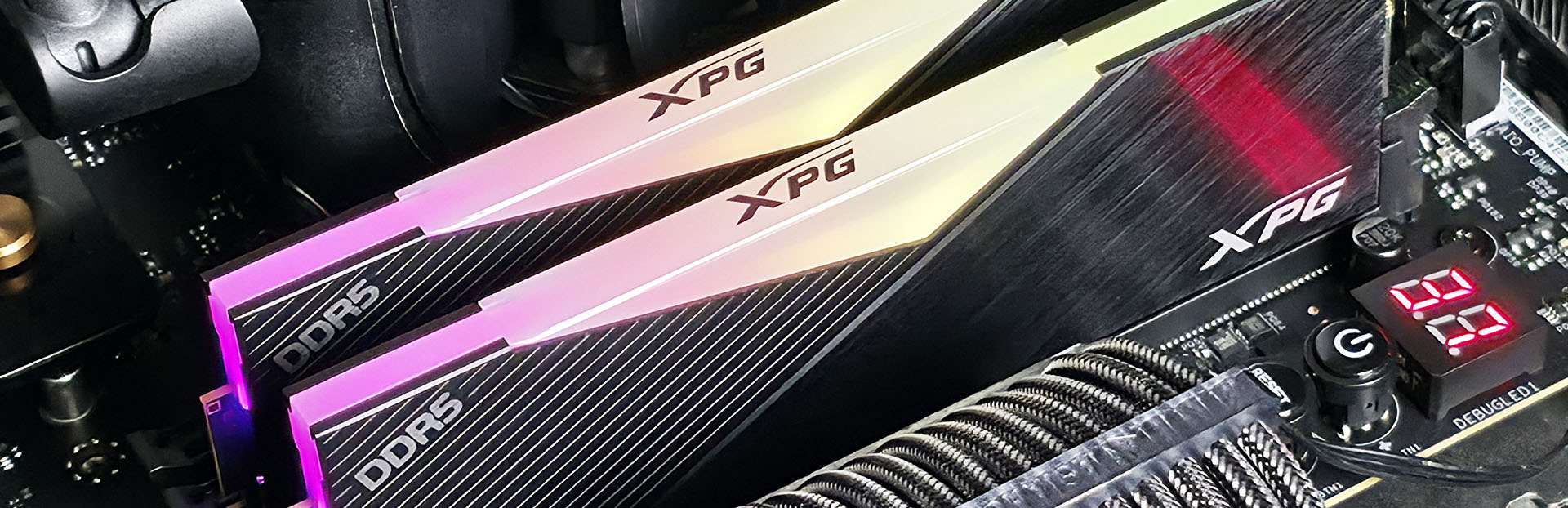
ADATA’s choice of Hynix A-die ICs further reinforces this. These chips are known for their overclocking potential, and the LANCER RGB leverages that with a PMIC (Power Management IC) to ensure clean power delivery. The result? No micro-stutters in Alan Wake 2, no thermal throttling in Microsoft Flight Simulator, and near-flawless performance in productivity workloads.
Beyond the Specs: A Kit Built for Creators
The LANCER RGB isn’t just for gamers. Its ECC support makes it viable for content creators running Ryzen 7 9850X3D in 4K video editing or AI rendering. Pair it with an RTX 4080, and the system handles PCIe 5.0 NVMe SSDs without bottlenecking—critical for large project files. The kit’s RGB lighting, while subtle, syncs with XPG Prime software for customization, adding a touch of flair without distracting from performance.
For users who prioritize capacity over marginal speed gains, the 64GB configuration is a game-changer. Most 64GB DDR5 kits max out at 48GB of usable capacity due to dual-channel limitations, but ADATA’s design delivers the full 64GB—ideal for multitasking between Blender renders and Cyberpunk 2077 at 1080p with RT enabled.
The takeaway? In the era of AMD’s infinite cache, memory speed alone doesn’t dictate performance. The XPG LANCER RGB DDR5-6000 proves that the right balance of speed, timings, and chip quality can outperform faster—but more volatile—alternatives.