For engineers who need raw compute in a tight footprint, ZOTAC’s latest trio of mini PCs redefines what fits inside a desktop. The smallest, the Magnus One Ultra, crams an NVIDIA GeForce RTX 5080 at reference clocks into a volume barely larger than a shoebox—11.46 liters—and pairs it with Intel Core Ultra 7 265, two DDR5 SO-DIMM slots (CSODIMM-ready), and dual M.2 NVMe drives (Gen 4 and Gen 5). It’s built for workstations that demand both AI acceleration and desktop performance without sacrificing space.
Beside it sits the Magnus EN275060T8, a more compact sibling with an RTX 5060 Ti 8 GB, targeted at mobile-on-desktop (MoDT) setups. It swaps in Intel Core Ultra 7 255HX and keeps the same DDR5 memory flexibility but scales back to one Gen 5 M.2 slot. Both run on Wi-Fi 7 (160 MHz), Bluetooth 5.4, and Thunderbolt 4—one with DisplayPort passthrough from the GPU, the other from the CPU’s iGPU.
Where things get more specialized is the ZP-THOREDGE-DX1, designed for industrial IoT and robotics. It skips traditional GPUs in favor of NVIDIA Jetson Thor T5000, delivering 2040 FP4 TFLOPS of local compute paired with 128 GB of 256-bit LPDDR5X memory and a 1 TB Gen 4 NVMe SSD. Industrial I/O includes RS232, RS485, CAN, GPIO, and USB 3.2 (10 Gbps), plus dual M.2 B-key slots for WLAN cards or 5G modems. Power is industrial-grade, supporting 9 V to 36 V inputs.
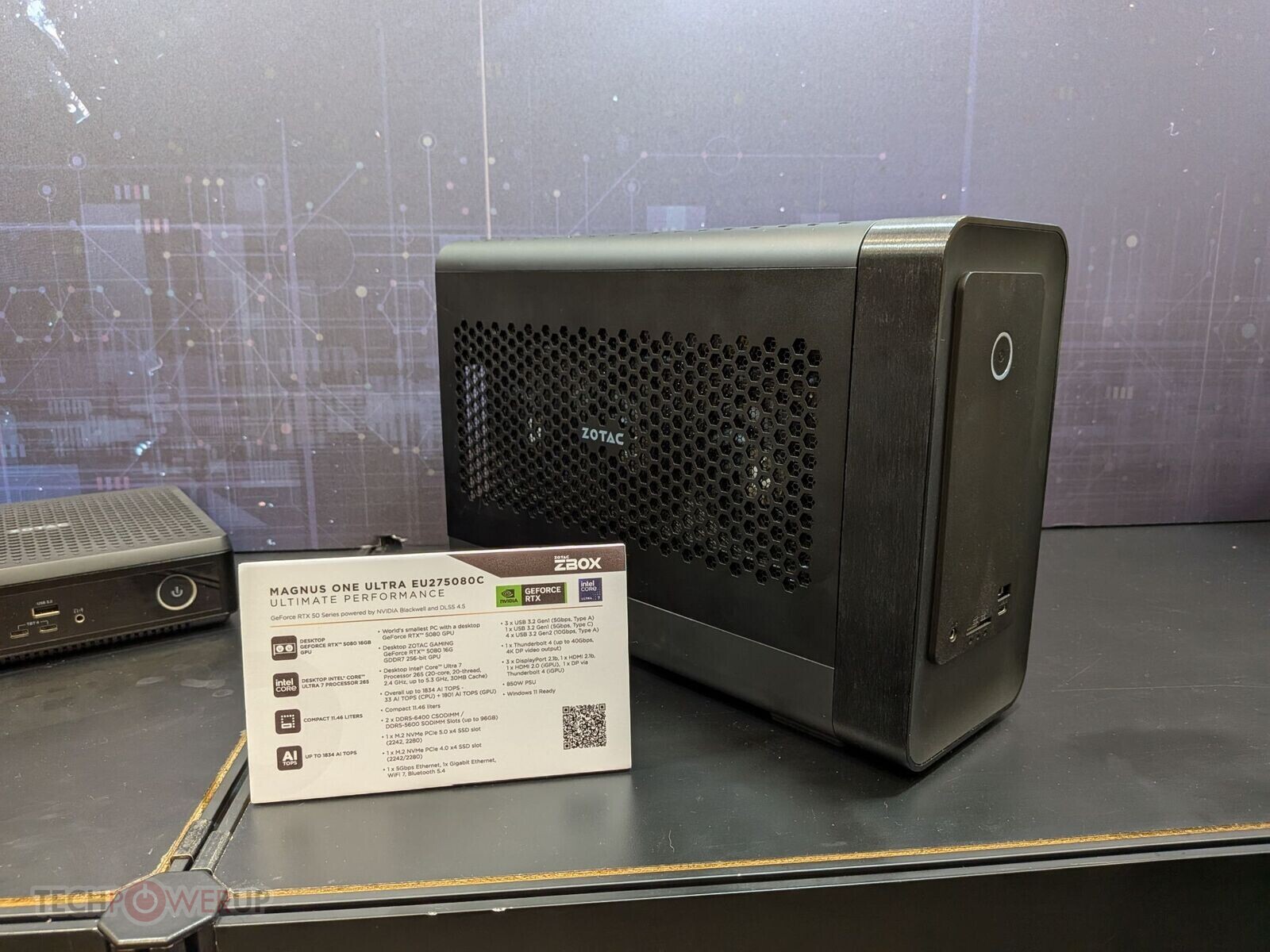
- Magnus One Ultra:
- GPU: NVIDIA GeForce RTX 5080 (reference clocks)
- CPU: Intel Core Ultra 7 265 (8P+12E, 65 W)
- Memory: Two DDR5 SO-DIMM slots (CSODIMM-ready)
- Storage: One M.2 Gen 4, one M.2 Gen 5
- Connectivity: Wi-Fi 7 (160 MHz), Bluetooth 5.4, 5 GbE LAN, two Thunderbolt 4 (one with GPU passthrough)
- Power: 850 W PSU with 12V-2x6 for 600 W RTX 5080 support
The RTX 5080 model is the standout for pure performance, offering desktop-class graphics in a form factor that challenges traditional tower builds. Its 600 W 12V-2x6 connection ensures stable power delivery without thermal compromise, while the dual Thunderbolt 4 ports add versatility for external displays or peripherals. The industrial Thor T5000 box, meanwhile, is built for environments where space and power input flexibility are critical—though its 36 V limit may require external conversion in some setups.
ZOTAC has a history of pushing mini PC boundaries, but these designs push further into both high-end workstation and industrial niches. Whether it’s the RTX 5080’s compactness or the Thor T5000’s specialized I/O, each model targets specific workloads where traditional desktops are too bulky. For gamers or AI developers, the Magnus One Ultra offers a glimpse of what’s possible when cooling and power delivery are optimized for extreme GPUs in small packages. For robotics, the ZP-THOREDGE-DX1 delivers compute density without sacrificing industrial ruggedness.
Pricing and availability remain unconfirmed, but if past trends hold, these models will likely launch with premium pricing to justify their specialized hardware. Buyers should expect a focus on enterprise and industrial channels for the Thor T5000 variant, while the RTX 5080 model may appeal to enthusiasts willing to pay for ultra-compact performance.