Apple has released Xcode 26.3, a major update to its developer platform that embeds artificial intelligence agents directly into the IDE. Unlike previous iterations, this version introduces agentic coding, where tools like Anthropic’s Claude Agent and OpenAI’s Codex can autonomously handle complex development tasks—from parsing project structures to generating and validating code changes—while leveraging Xcode’s built-in tools.
The update builds on Xcode 26’s AI-assisted coding features by granting agents deeper access to the development environment. They can now search documentation, traverse file hierarchies, modify project settings, and even review changes using Xcode Previews before compiling. This integration is designed to accelerate iteration cycles, allowing developers to offload repetitive or time-consuming tasks while maintaining control over the final output.
A New Era of Autonomous Development
Xcode 26.3 doesn’t just assist with code completion—it enables agents to act as collaborative partners throughout the entire development lifecycle. For example, an agent could analyze a project’s architecture, suggest optimizations, and automatically apply fixes after reviewing a preview of the UI changes. The system also supports visual validation, where agents can capture and iterate on Xcode Previews before finalizing builds, reducing manual review steps.
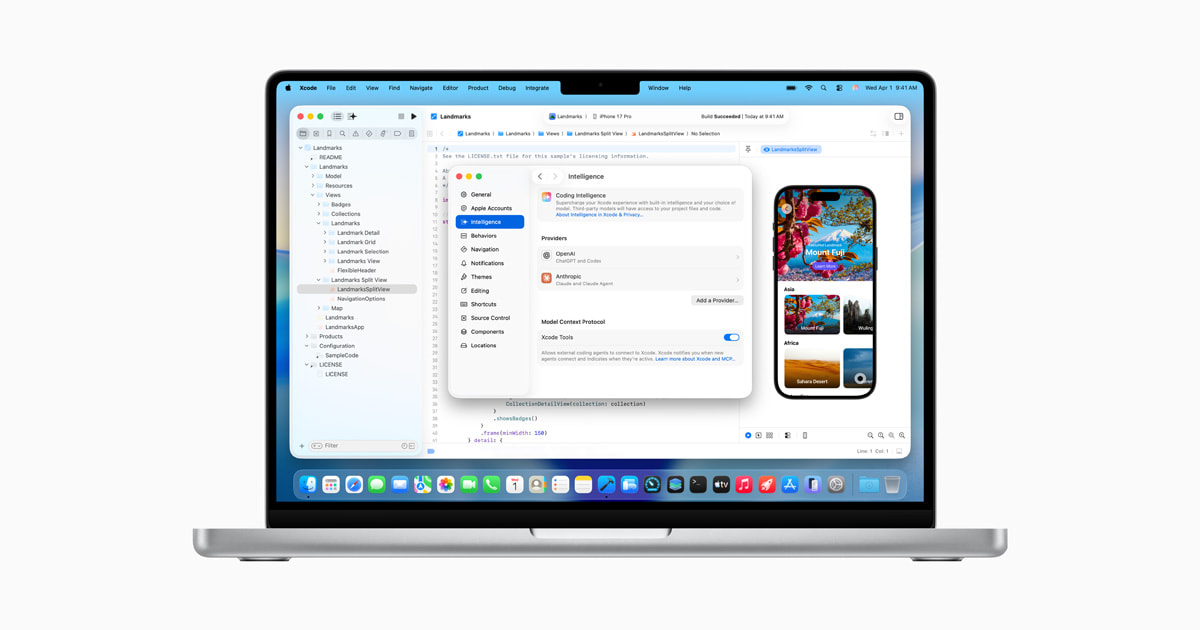
Developers gain flexibility by choosing between built-in agents like Claude and Codex, both of which are optimized for Apple platforms. Additionally, Xcode 26.3 introduces the Model Context Protocol, an open standard that allows third-party agents or tools to integrate seamlessly with the IDE. This means future AI models—whether from Apple, competitors, or startups—could plug into Xcode without requiring custom adaptations.
Who Benefits?
This update is primarily aimed at professional developers working on Apple ecosystems, particularly those managing large-scale projects or teams. Smaller studios or solo developers may find the most immediate value in streamlined documentation searches and automated fixes, while enterprises could leverage agentic coding to standardize workflows across engineering teams. The tradeoff? Agents require internet connectivity to function, and reliance on third-party models may introduce latency or dependency risks.
For Apple, the move aligns with its broader push to democratize advanced tooling while maintaining control over the developer experience. By embedding AI directly into Xcode—rather than relying on external plugins—the company ensures compatibility and performance without sacrificing security.
Availability and Next Steps
Xcode 26.3 is now available as a release candidate for all members of the Apple Developer Program. A final version will follow shortly, distributed via the App Store. Users should note that Anthropic and OpenAI’s terms of service apply to agent usage, and Apple has emphasized that the protocol remains open for future integrations.