users increasingly rely on docking stations to expand their workspace, yet few integrate a feature that has become essential for modern smartphones: wireless charging. While standalone wireless chargers are common, docking stations rarely include this capability, leaving users with a practical gap—especially as USB-C ports degrade over time, leading to costly repairs or replacements.
This oversight is notable because the long, flat surface of most docks makes them ideal platforms for wireless charging. Yet, only three models stand out for addressing this need, each balancing functionality and cost in distinct ways. Their availability marks a shift toward more integrated solutions, one that could redefine how users manage power and connectivity at their desks.
The Performance Master 10-in-1 USB-C Docking Station is the budget-friendly option, offering a compact design with a tilted front to balance a phone. It delivers 7.5W for iPhones and 10W for Android devices, though it lacks the fast-charging speeds of newer flagship models. Despite this limitation, it provides essential features: three USB 3.0 ports (5Gbps), an HDMI port capable of 4K/60Hz output, a USB-C port, an SD/TF card slot, and a headphone jack. It can supply up to 100W to the laptop, though real-world usage suggests 90W is more practical. A notable drawback is that it does not include a charger brick, requiring users to provide their own.
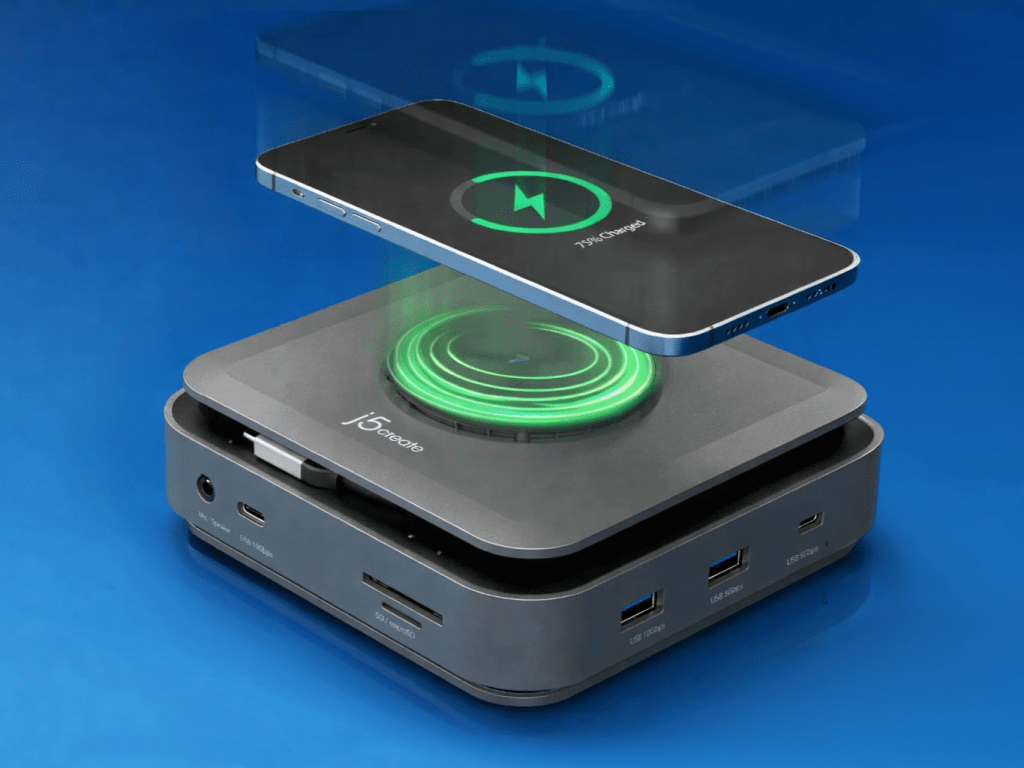
The mid-range J5Create USB-C Dual 4K HDMI Docking Station takes a different approach with a squarish design and a circular wireless charging platform on top. It supports up to 15W of wireless charging, which is sufficient for most phones but not the fastest-charging models. The dock itself is impressive, offering two HDMI ports (one at 4K/60Hz and another at 4K/30Hz), two USB-A and USB-C ports (10Gbps and 5Gbps respectively), a microSD/SD card slot, and the ability to deliver up to 140W to the laptop. However, it also does not include a charger brick, and wireless charging is limited if the provided charger supplies less than 60W.
The premium Anker 675 USB-C Docking Station stands out for its design, resembling more of a monitor stand than a traditional dock. It includes a wide aluminum slab that serves as the wireless charging surface, delivering up to 10W (7.5W for iPhones). While this is not the fastest charging speed, it compensates with 45W through wired USB-C ports and 100W to the laptop. Unlike the other two models, it includes a charger brick. The dock also features an HDMI 2.0 port for 4K/60Hz output, gigabit Ethernet, three 10Gbps USB-A ports, and a UHS-1 (104MB/s) SD/microSD slot.
These docking stations address the practical need for wireless charging while also offering a range of features that cater to different user requirements. The Performance Master model is ideal for users looking for a budget-friendly solution with essential connectivity options, while the J5Create and Anker models provide more advanced features and power delivery capabilities at higher price points.
The absence of wireless charging in most docking stations highlights a broader trend: manufacturers often prioritize core docking performance—stable displays, fast data transfer, Ethernet, and reliable laptop charging—over additional conveniences like wireless charging. This decision is driven by cost, complexity, thermal management, and engineering risks. Wireless chargers introduce high-frequency transmissions that can complicate EMI/EMC compliance and internal layout, making them a less appealing addition for many brands.
For developers and professionals who rely on docking stations to expand their workspace, these three models offer a practical solution that integrates wireless charging without compromising on essential features. As the demand for seamless connectivity grows, it is likely that more manufacturers will explore similar integrations, potentially making this feature more common in future docking solutions.