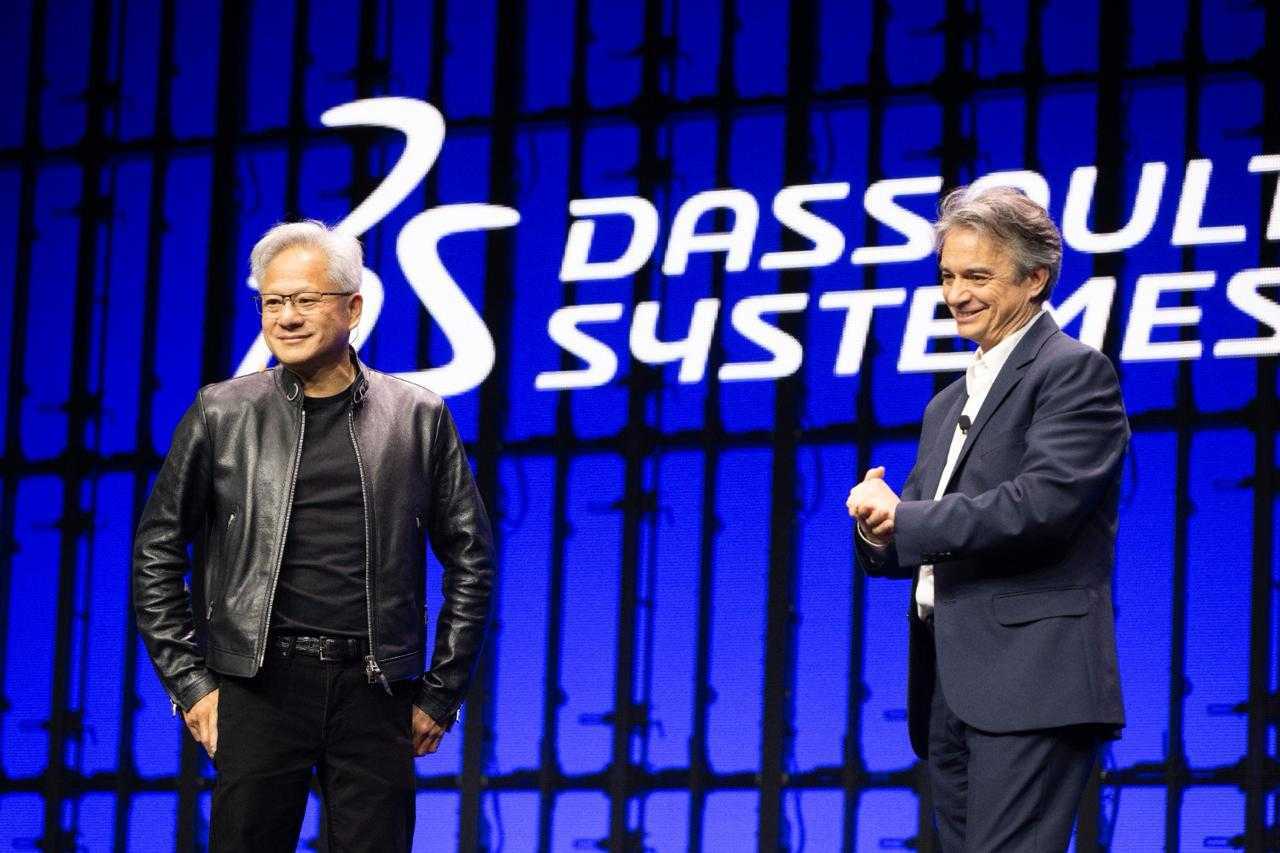
Two industry giants have outlined a vision for the future of engineering that could reshape how products are designed, tested, and manufactured. NVIDIA and Dassault Systèmes announced a deepened collaboration to merge AI-driven simulation with Dassault’s virtual twin platforms, creating what they call Industry World Models—self-optimizing digital replicas of physical systems that can predict behavior before a single prototype is built.
At the heart of this shift is the idea that AI will no longer be a tool bolted onto workflows but the foundation of an entirely new computing paradigm. The partnership aims to enable engineers to explore design spaces 1,000 times larger than before, with AI companions handling repetitive tasks while humans focus on innovation.
The move builds on decades of collaboration between the two companies, but this time, the scale is unprecedented. The goal is nothing short of redefining how industries approach discovery, from drug development to autonomous manufacturing.
What Changes Now?
The partnership integrates NVIDIA’s accelerated computing and AI libraries—including CUDA-X and Omniverse—with Dassault’s 3DEXPERIENCE platform. This fusion allows engineers to simulate not just geometry but the dynamic behavior of materials, biological systems, and entire factories in real time. The result is a system that can generate, test, and optimize designs at an industrial scale, reducing reliance on physical prototypes.
Key applications include
- Biology and Materials Science: Combining NVIDIA’s BioNeMo platform with Dassault’s BIOVIA to accelerate molecular discovery and next-gen material design.
- AI-Powered Engineering: SIMULIA’s Virtual Twin Physics, enhanced with NVIDIA’s AI physics libraries, will enable instant, accurate predictions for design validation.
- Software-Defined Factories: Omniverse’s physical AI integrated into DELMIA Virtual Twin will create autonomous production systems, where factories are designed, simulated, and operated entirely in software.
- AI Companions: A new class of virtual assistants, powered by NVIDIA’s Nemotron models and Dassault’s Industry World Models, will provide engineers with context-aware intelligence, eliminating repetitive tasks and expanding creative capacity.
This isn’t just about speeding up existing workflows—it’s about enabling entirely new ways of thinking. For example, in drug discovery, AI companions could simulate thousands of molecular interactions in hours rather than months, while in manufacturing, factories could be optimized in virtual environments before a single machine is assembled.
Who Benefits?
The impact will be felt across industries where precision, speed, and scalability matter most. Aerospace, automotive, pharmaceuticals, and consumer goods manufacturers are likely early adopters, but the technology could eventually extend to fields like energy, agriculture, and even urban planning.
For the 45 million users of Dassault’s 3DEXPERIENCE platform, this means access to AI-driven tools that turn virtual twins into knowledge factories—systems where insights are generated, validated, and trusted before any physical construction begins. The shift is designed to reduce costly errors by identifying flaws in simulation rather than in production.
Manufacturers will also gain the ability to deploy AI factories through Dassault’s OUTSCALE sovereign cloud, ensuring data residency and security while running high-performance AI workloads across multiple continents.
How Will This Roll Out?
The collaboration will unfold in phases, with immediate integration of existing tools like SIMULIA and DELMIA enhanced by NVIDIA’s AI capabilities. Over time, the focus will expand to broader adoption of Industry World Models, where AI companions become standard across engineering teams.
NVIDIA and Dassault Systèmes emphasized that the goal is not to replace engineers but to amplify their work. AI companions will handle exploratory and repetitive tasks—such as running simulations, optimizing designs, or analyzing failure modes—freeing humans to focus on high-level innovation.
For example, in materials science, engineers could define the properties they need, and AI would generate candidate materials, simulate their behavior under various conditions, and even suggest modifications before a single sample is synthesized.
What’s Next?
While the partnership is still in its early stages, the long-term vision is clear: a world where every product, process, and factory exists first as a digital twin, optimized by AI before it enters the physical realm. This could lead to breakthroughs in fields where trial and error are costly—such as drug development, where failures can take decades and billions of dollars to correct.
Industry observers will watch closely as the first AI companions and Industry World Models hit production environments. Success will depend on whether the technology delivers on its promise of 100 to 1,000 times greater efficiency—and whether engineers embrace the shift from manual design to AI-augmented creativity.
One thing is certain: the collaboration signals a fundamental rethinking of how industries approach innovation. If executed successfully, it could mark the beginning of a new era in engineering—one where the digital world doesn’t just mirror the physical, but actively shapes it.