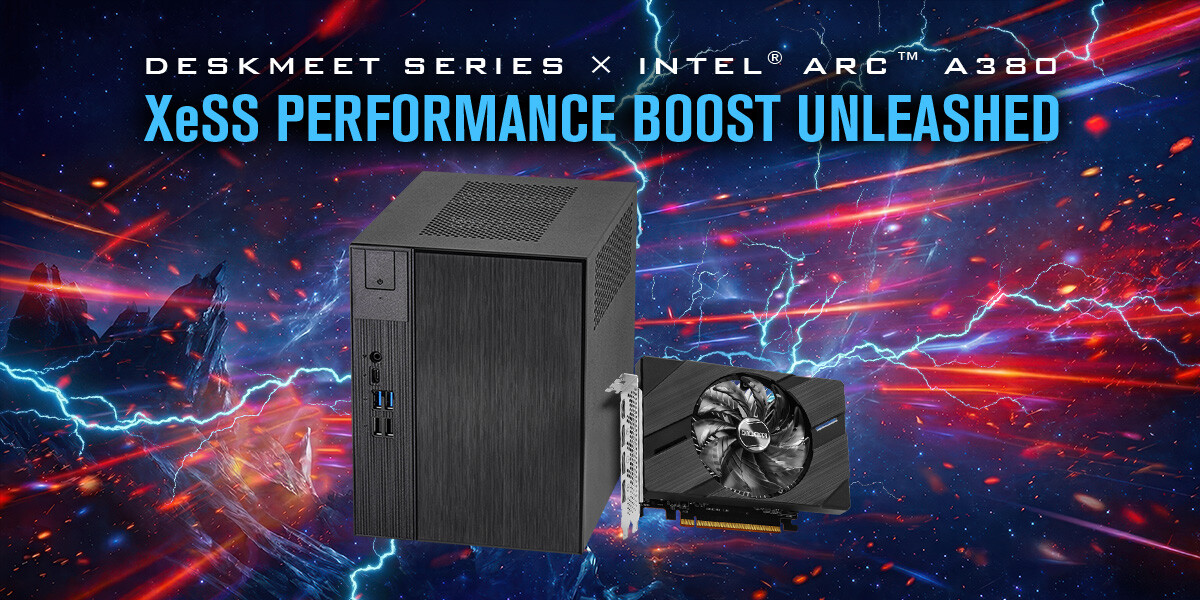
The search for cost-effective high-performance builds has never been more urgent. GPU and memory prices continue to shift unpredictably, forcing system builders to rethink how they balance power and affordability. Enter the DeskMeet Series—a line of mini PCs designed to pair seamlessly with discrete graphics cards while keeping costs in check. When paired with Intel’s Arc A380 Challenger ITX 6GB OC, the platform promises a mainstream gaming experience that rivals established GPUs like the RX 6600, but without the same premium price tag.
At its core, this configuration hinges on XeSS 3, Intel’s latest AI-driven upscaling technology. Enabled through optimized drivers, it claims to deliver near-native 1080p performance from a card that, on paper, wouldn’t normally match the frame rates of more powerful GPUs. The result, if the claims hold, is smoother gameplay with minimal quality loss—an appealing proposition for gamers who prioritize fluidity over raw resolution. But whether this translates to real-world savings remains an open question.
Performance and Flexibility in a Compact Form
The DeskMeet Series isn’t just about gaming, though. Its design supports four memory slots, making it adaptable for both mainstream builds and potential living-room Steam Machine setups. The platform’s highly integrated nature simplifies assembly while leaving room for future upgrades, a practical approach in an era where component lifespans are increasingly uncertain.
The Arc A380 itself brings more than just gaming performance to the table. AV1 encoding and decoding support adds a layer of media processing capability, useful for content creators looking to leverage Intel’s hardware without stepping into professional-grade territory. This dual role—gaming and light production—could broaden its appeal beyond traditional PC builds.
Where the Value Proposition Stays Unproven
That said, the value proposition isn’t guaranteed. While the combination of Arc A380 and XeSS 3 aims to deliver RX 6600-level performance, the actual price point remains unconfirmed in public announcements. If the final cost doesn’t justify the trade-offs—such as relying on upscaling for frame rates rather than native resolution—the platform risks becoming a niche experiment rather than a mainstream alternative.
There’s also the question of driver maturity. XeSS 3 is a powerful tool, but its effectiveness depends on consistent software support. Early adopters may find themselves at the mercy of Intel’s optimization pipeline, a risk that’s easier to ignore in high-end builds where performance gaps are expected. For budget-conscious builders, every hiccup could feel more pronounced.
In the current market, where GPUs like the RX 9070 XT and Arc B770 are pushing boundaries, this mini PC platform doesn’t aim for the top tier. Instead, it targets a sweet spot between performance and affordability—a space that’s growing tighter as memory costs and competition heat up. Whether it lands there or gets lost in the shuffle will depend on how aggressively Intel drives down prices and how reliably XeSS 3 delivers on its promises.
For now, the DeskMeet Series with Arc A380 remains a concept rather than a concrete product for most builders. The lack of confirmed pricing leaves room for speculation, but one thing is clear: it’s entering a landscape where value isn’t just about specs—it’s about sustainability in an unpredictable hardware market.