The isometric perspective in role-playing games is often seen as a technical compromise—a way to balance 3D movement with 2D simplicity. But in Disco Elysium, that same perspective became a deliberate artistic choice, transforming the game’s world into a carefully composed painting. The art direction behind this decision didn’t come from a desire to follow convention. Instead, it emerged from a radical reinterpretation of how isometric graphics could function as a narrative device.
At the heart of this approach was Aleksander Rostov, the game’s art director, whose insights into the project’s visual language offer a rare glimpse into how abstract concepts—like framing, texture, and motion—were weaponized to serve the game’s themes. For a team that rejected traditional RPG aesthetics, the isometric perspective wasn’t a limitation. It was a blank slate.
Flatness as a creative tool
Isometric graphics, by their nature, are static in a way that 3D perspectives aren’t. There’s no parallax shift, no dynamic camera angles, no depth of field to distract from the composition. To Rostov, this flatness was liberating. It allowed the team to treat the game’s world as if it were a single, unchanging image—one that could be designed like a painting. The challenge wasn’t rendering movement or perspective shifts; it was controlling the viewer’s eye through deliberate visual cues.
This philosophy wasn’t born in isolation. The team studied a 2014 video from Obsidian Entertainment, detailing how Pillars of Eternity rendered its isometric world. What started as a technical reference became the foundation for Disco Elysium’s visual identity. By applying modern art principles—contrast, texture, and the strategic placement of visual weight—they turned isometric rendering into something far more expressive than a simple 3D workaround.
Painting with pixels
The result is a game where every corner of the screen is loaded with meaning. Shadows aren’t just lighting effects; they’re used to create depth and guide the player’s gaze. Textures aren’t filler; they’re tools to emphasize activity in one area while keeping another clean and readable. Even motion lines—subtle strokes that imply movement—were borrowed from comic book art to direct attention toward key elements, like the looming presence of a character or the intricate details of a setting.
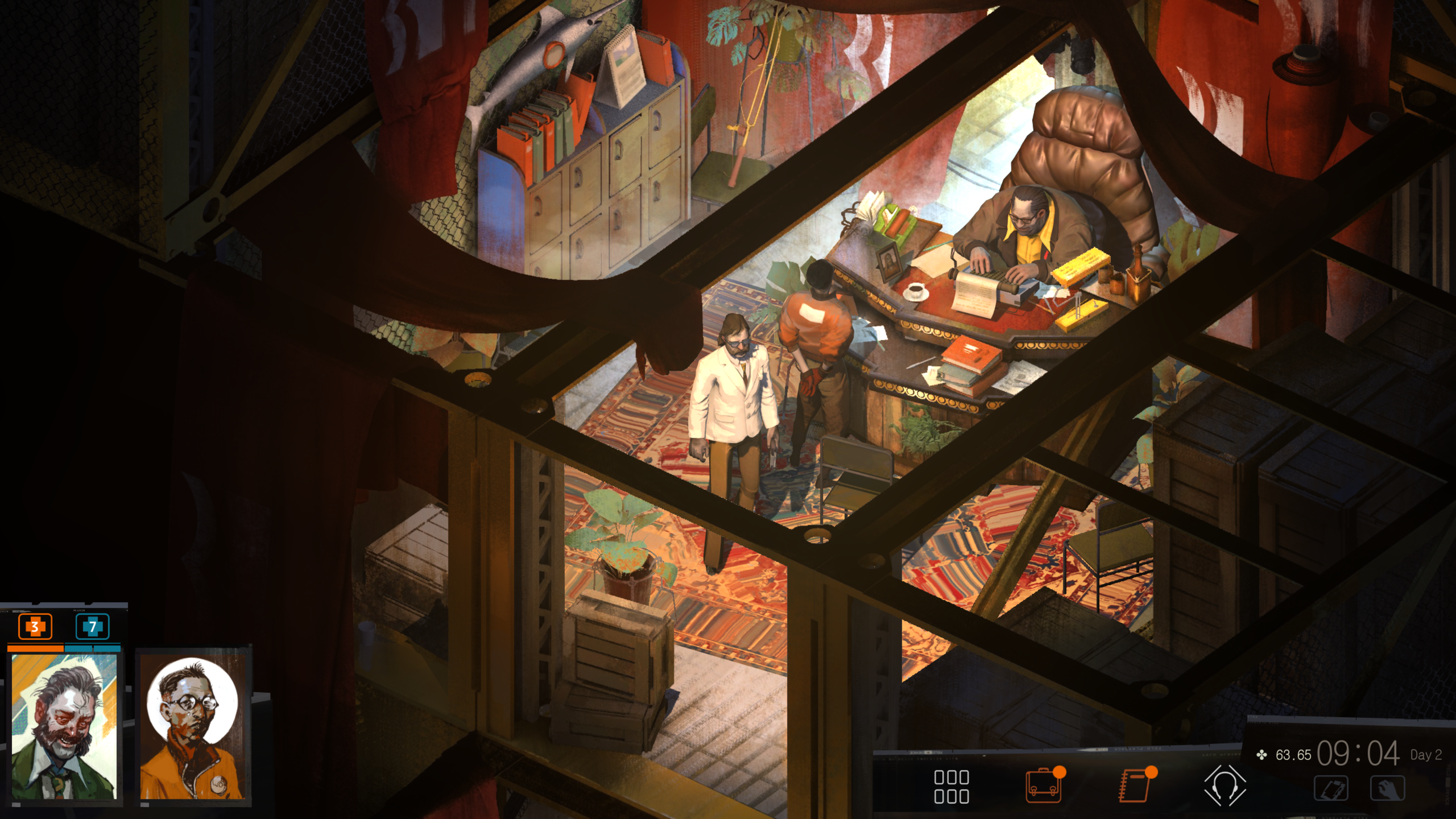
Consider the encounter with Evrart Claire, the union boss. The composition doesn’t just place him in a room; it frames him as a dominant figure, with the player trapped between rigid, comic-book-style panels. The surroundings reinforce his power—comfortable seating, deliberate lighting—while the player is visually confined, emphasizing the imbalance of their meeting. It’s a dynamic that feels organic to the game’s themes of class struggle and existential dread.
A collaborative canvas
The execution of this vision wasn’t Rostov’s work alone. Concept artist Kaspar Tamsalu played a crucial role in designing locations and dialogue frames, treating each scene as a miniature comic strip. His influence is visible in how characters and environments are compartmentalized, with clear visual separations that mimic the structure of a painting’s layers. Even the thought cabinet—a central mechanic in the game—was designed with this principle in mind, using typography and layout to create a sense of depth within a flat interface.
Yet for all the collaboration, one name stands out by its absence in discussions of the game’s art: Anton Vill, the illustrator behind the thought cabinet. Though not directly credited in the game’s development, Vill’s work on Zero Parades for Dead Spies—a follow-up project from the same studio—carries the same painterly sensibilities. His absence from the documentary isn’t just a technical oversight; it’s a reminder of how deeply the game’s visual language was shaped by individual contributions, each playing a part in turning an isometric grid into a masterpiece.
When critics describe Disco Elysium as a work of art, they’re not just praising its writing or its philosophical depth. They’re acknowledging how its visual design elevates the medium. By treating the isometric perspective as a canvas rather than a constraint, the team behind the game proved that even the most traditional of RPG conventions could be reimagined. The result isn’t just a game that looks different—it’s one that feels like stepping into a living painting, where every detail has been placed with intention.