For PC builders prioritizing cooling precision over cost, the DeltaMate MPII series arrives as a measured evolution—tighter fin tolerances, reinforced brass threading, and borosilicate glass that resists edge chipping. It’s not a radical departure from previous designs, but incremental improvements that matter in systems where every millimeter of heat dissipation counts.
The most noticeable change is the microfin architecture. On AMD AM5 models, 25 fins with 0.2 mm slots sit directly over CCDs (Core Complex Dies), while 29 fins with 0.4 mm width handle I/O die flow. Intel LGA1851 variants increase that to 40 ultra-fine fins for CPU tiles and 30 wider fins for peripheral cooling. The result is a larger effective surface area without sacrificing coolant velocity—a balance that’s harder to achieve in custom water blocks.
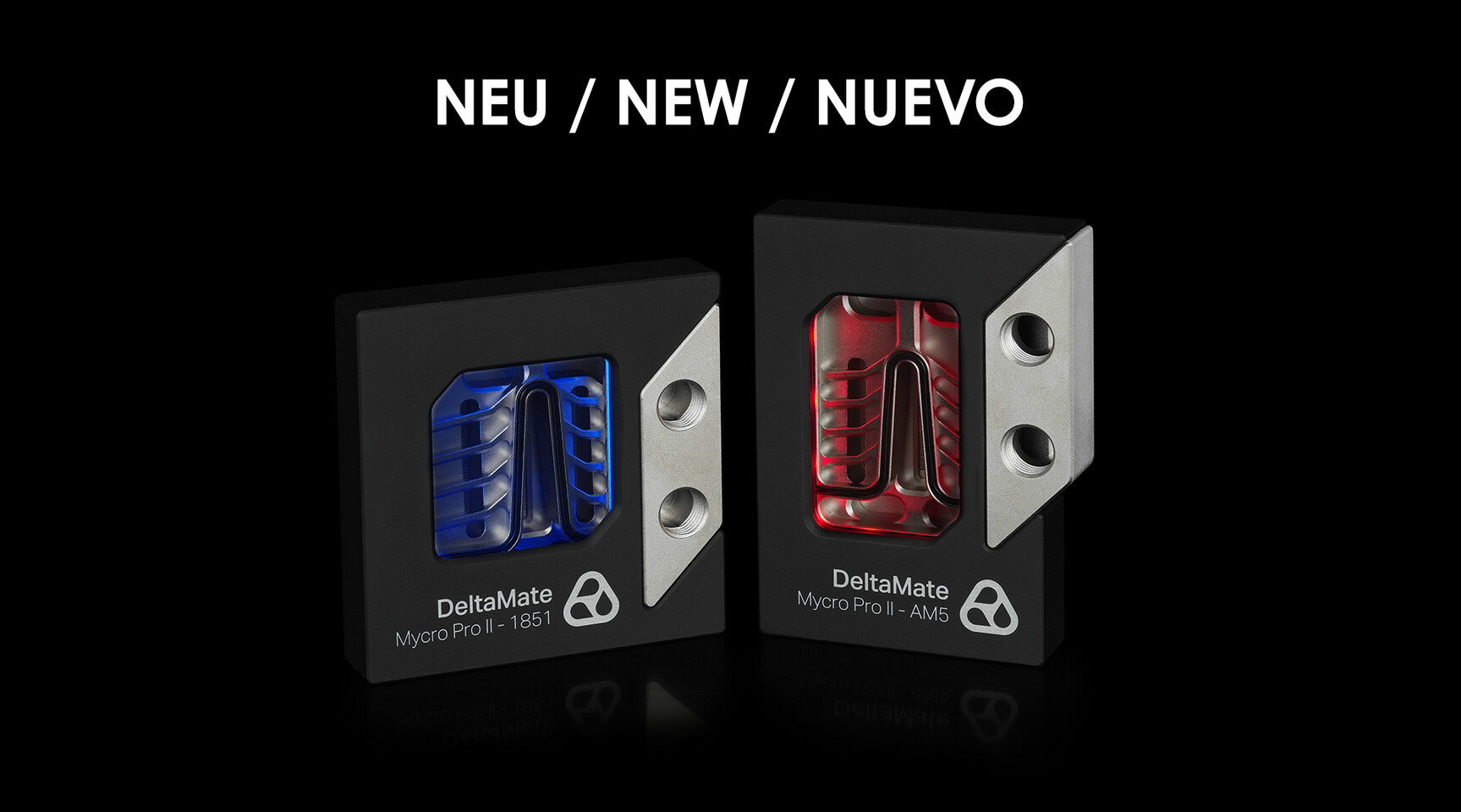
- Material & Build:
- Nickel-plated copper cold plate (AM5/Intel)
- Brass G1/4-inch threaded inserts
- Borosilicate glass viewing window with sanded edges
- Anodized aluminum cover for screw concealment
- Connectivity & Control:
- 3-pin ARGB header (5V/DATA/GND) via motherboard
- Compatibility:
- AMD AM5 (backward to AM4)
- Intel LGA1851 (backward to LGA1700)
The 3-pin ARGB header is a practical detail—no external controller required, just plug-and-play illumination. Whether you’re running a single-loop setup or a complex network of blocks, the standard G1/4-inch ports ensure compatibility without forcing custom fittings.
Who this is for: Enthusiasts building systems around 2 nm CCDs (like upcoming Zen 6) or Intel’s 5.6 GHz boost chips, where fine-tuning thermal headroom prevents throttling under sustained loads. The tradeoff? Price remains premium; no word yet on exact figures, but past DeltaMate models have sat at the top end of the market.
What remains unclear: Whether the microfin density will translate to measurable cooling gains over 0.25 mm fin blocks, or if the added cost justifies the incremental improvement in real-world temperatures. Early adopters with fine-grained logging may have answers by mid-year.