Edge computing is no longer just about speed—it’s about resilience, adaptability, and silence. BIOSTAR’s latest EdgeComp MS-1335U redefines the balance between raw processing power and operational stealth, positioning itself as a workhorse for smart cities, industrial automation, and AI-driven environments where noise is unacceptable.
At its core, the MS-1335U runs on Intel’s 10-core Raptor Lake Core i5-1335U, a chip designed to deliver sustained performance under tight thermal constraints. This isn’t just a matter of clock speeds; it’s about efficiency. The processor’s architecture allows it to handle data-heavy workloads—whether real-time analytics or multi-screen digital signage—without the need for aggressive cooling. That translates to longer uptime, lower maintenance costs, and zero fan noise in environments where silence is non-negotiable.
But performance isn’t one-dimensional here. The MS-1335U doesn’t just stop at CPU power; it extends its capabilities with optional discrete graphics support via the AMD Radeon RX 7900 XTX. This isn’t a half-measure for gaming or content creation—it’s a deliberate move to future-proof edge deployments that may demand high-end rendering, AI inference, or even light virtualization. The combination of Intel’s CPU and AMD’s GPU creates a platform that can scale from basic data processing to complex visual workloads without skipping a beat.
Key Specifications
- Processor: Intel Core i5-1335U (Raptor Lake, 10 cores, up to 4.7 GHz)
- Graphics: Optional AMD Radeon RX 7900 XTX (for high-end visual workloads)
- Memory: Up to 96 GB DDR5-5200 SO-DIMM (ECC support for mission-critical applications)
- Storage: M.2 Key-M slot (PCIe x4, supports multiple form factors)
- Displays: 4 simultaneous outputs (HDMI, DisplayPort, dual USB-C with 180 Hz refresh support)
- Networking: Dual Intel 2.5GbE LAN ports + optional 4G/5G SIM card slots
- Connectivity: Four COM ports for industrial peripherals, WiFi 6E (optional), Bluetooth 5.3 (optional)
- Power & Cooling: Fanless design with passive cooling, supports extended operation in non-ventilated spaces
- Form Factor: Compact embedded PC (dimensions not specified but optimized for edge deployment)
The technical details tell a clear story: this is built for environments where every watt matters and every millisecond counts. The DDR5-5200 SO-DIMM support, for example, isn’t just about raw bandwidth—it’s about enabling low-latency data processing for real-time applications like traffic management or predictive maintenance. Meanwhile, the M.2 Key-M slot with PCIe x4 isn’t just storage; it’s a gateway to adding accelerators for AI workloads without sacrificing space.
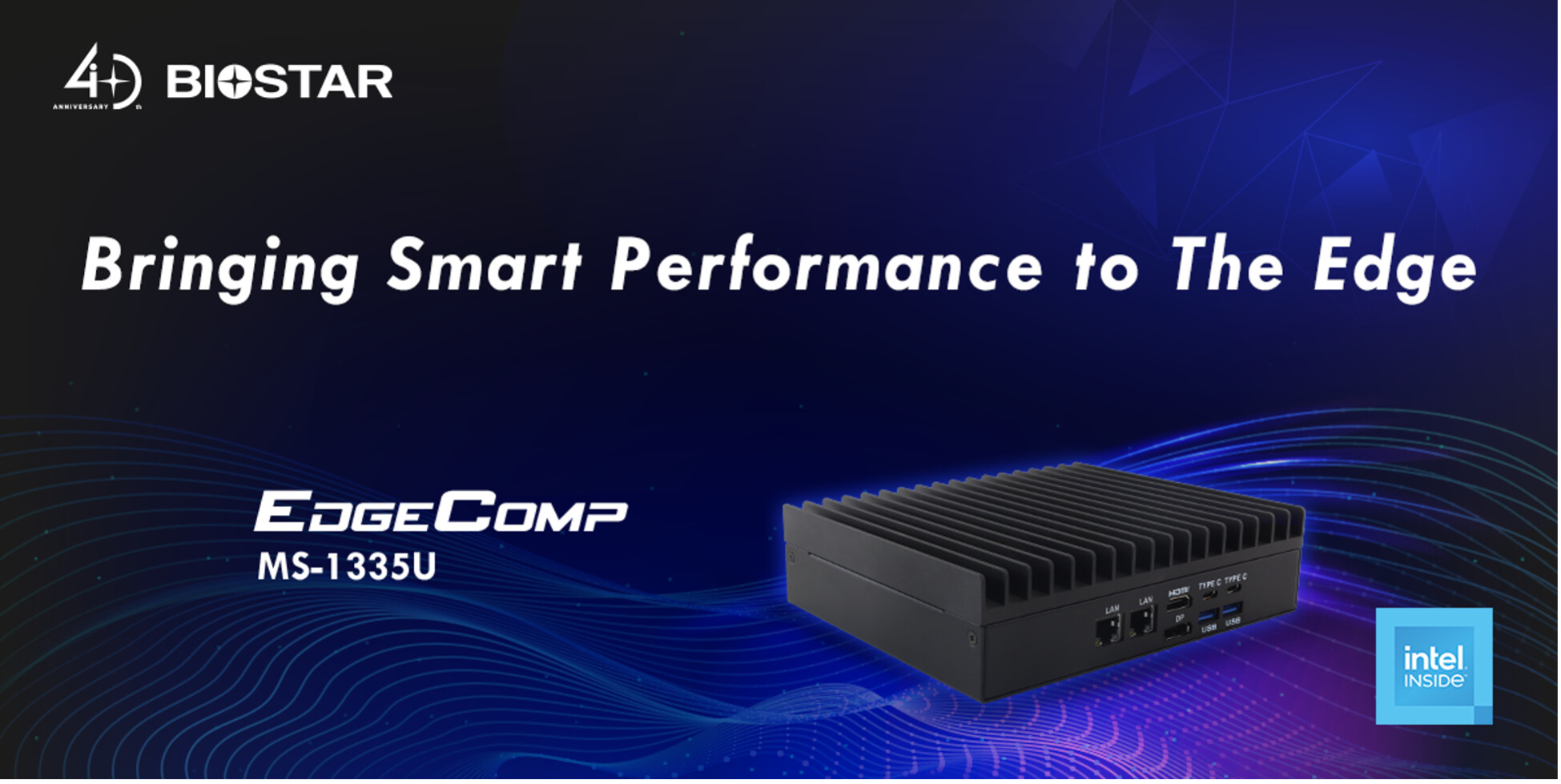
Then there’s the display flexibility: four simultaneous outputs, including dual USB-C ports capable of driving 180 Hz refresh rates. This isn’t just for digital signage—it’s for edge devices that need to handle multiple screens simultaneously, whether for robotics control interfaces or AI vision systems. The inclusion of DisplayPort and HDMI ensures compatibility with existing setups, while the USB-C ports future-proof deployments where mobility is a requirement.
Built for Edge-Level Reliability
The fanless design is more than a marketing gimmick—it’s a structural advantage. By eliminating moving parts, BIOSTAR removes a single point of failure in dusty or vibration-prone environments like factories or outdoor kiosks. The system can operate 24/7 without the risk of bearing degradation or noise pollution, which is critical for smart infrastructure where reliability is non-negotiable.
Networking is another area where the MS-1335U excels. Dual 2.5GbE LAN ports provide both bandwidth and redundancy, ensuring that edge nodes—whether in a smart grid or industrial IoT setup—can handle high-speed data without bottlenecking. The optional 4G/5G SIM card support takes this further, enabling truly mobile edge computing for applications like remote surveillance or logistics tracking.
Who is this for? Primarily, it’s for system integrators and OEMs building solutions where performance meets practicality. Smart cities need edge devices that can process sensor data without drawing excessive power; industrial automation requires platforms that can handle both control interfaces and AI vision simultaneously. The MS-1335U isn’t just a PC—it’s a platform designed to evolve with the needs of next-generation infrastructure.
Availability is expected in mid-2026, making it a key player at CES 2026, where the focus will likely shift toward AI-driven edge solutions and silent, high-efficiency computing. For now, BIOSTAR has set a new benchmark for what an edge PC can achieve without compromising on noise, power, or scalability.