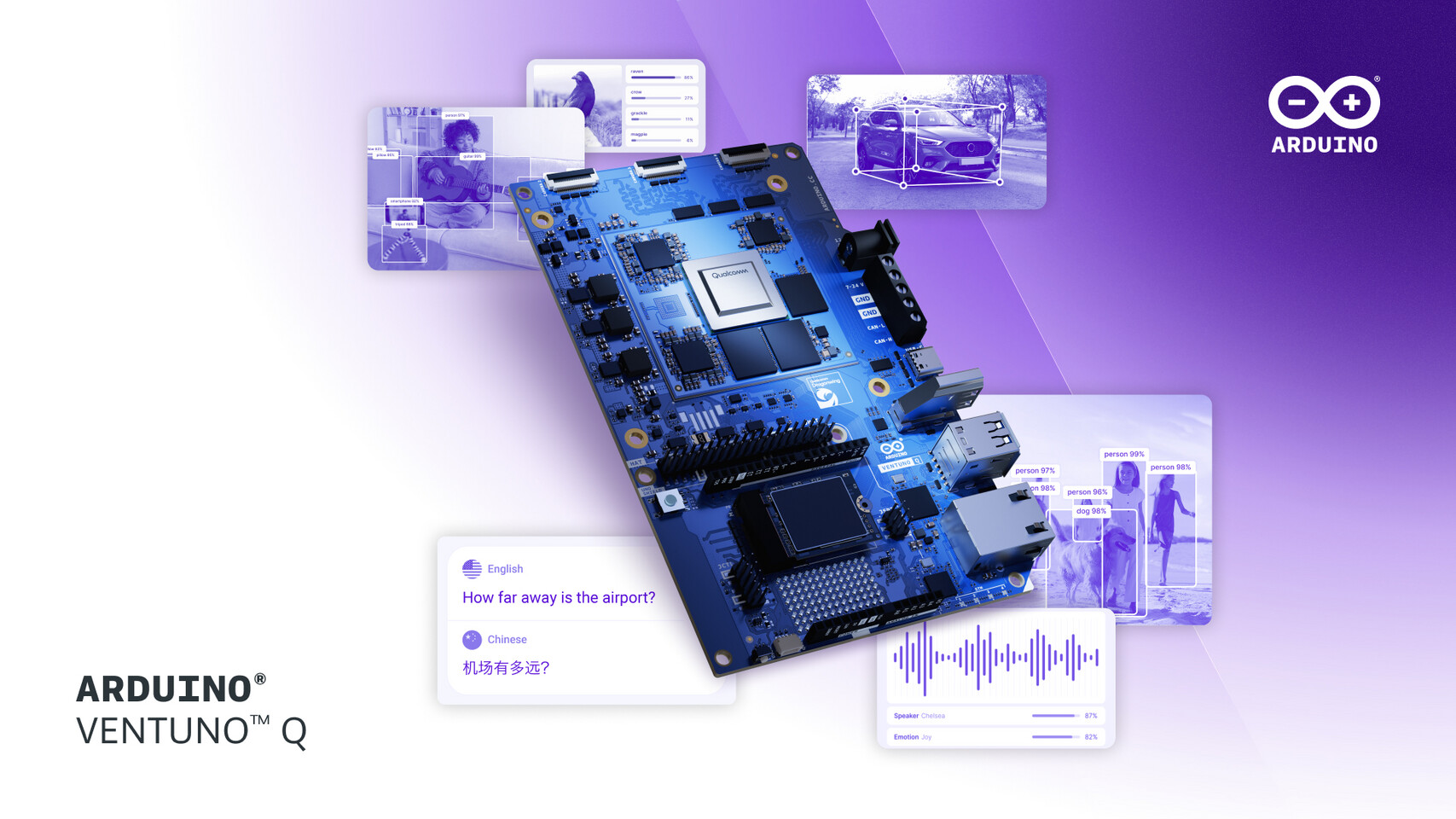
Balancing cutting-edge AI performance with real-world operational costs is a challenge many small businesses face when adopting edge computing solutions. Arduino’s latest platform, the VENTUNO Q, aims to address this by integrating Qualcomm’s Dragonwing IQ8 Series processor, designed for both traditional and generative AI workloads, while offering deterministic control through an STM32H5 microcontroller.
The platform promises up to 40 dense TOPS of NPU acceleration, 16 GB of RAM for multitasking, and expandable 64 GB storage. However, its true value lies in how it simplifies the development process—combining Ubuntu and Linux Debian support on the main processor with Arduino’s real-time microcontroller environment, all accessible through a unified development experience.
Specs and Capabilities
- Processor: Qualcomm Dragonwing IQ8 Series (AI-focused)
- NPU Acceleration: Up to 40 dense TOPS
- Microcontroller: STM32H5 for real-time control
- Memory: 16 GB RAM, expandable storage up to 64 GB
- Connectivity: MIPI-CSI cameras, 2.5 Gb Ethernet, industrial I/Os (CAN-FD, PWM)
- Software Support: Ubuntu, Linux Debian, Arduino Core on Zephyr OS
The platform is designed for applications requiring offline AI agents—such as voice assistants, robotic motion control, or edge vision systems. It also supports ROS 2 workflows and integrates with existing Arduino shields and sensors, ensuring compatibility with a wide range of hardware.
Who Benefits—and Who Should Cautiously Proceed
For small businesses or developers working on robotics, smart automation, or AI-driven quality inspection, the VENTUNO Q could streamline prototyping and deployment. Its unified development environment reduces the need for multiple devices, lowering both cost and complexity. However, the platform’s advanced capabilities come with a premium price point, making it less suitable for budget-conscious projects where simpler solutions would suffice.
A reality check: While the specs are impressive, long-term reliability and real-world performance under sustained workloads remain untested. Businesses should weigh the upfront investment against their specific needs—whether they require generative AI, vision processing, or low-latency control.
Availability is expected in Q2 2026 through Arduino’s official store and authorized resellers, with pricing yet to be confirmed. For those eyeing edge AI solutions, this platform could redefine efficiency—but only if the tradeoff between power and cost aligns with their operational goals.