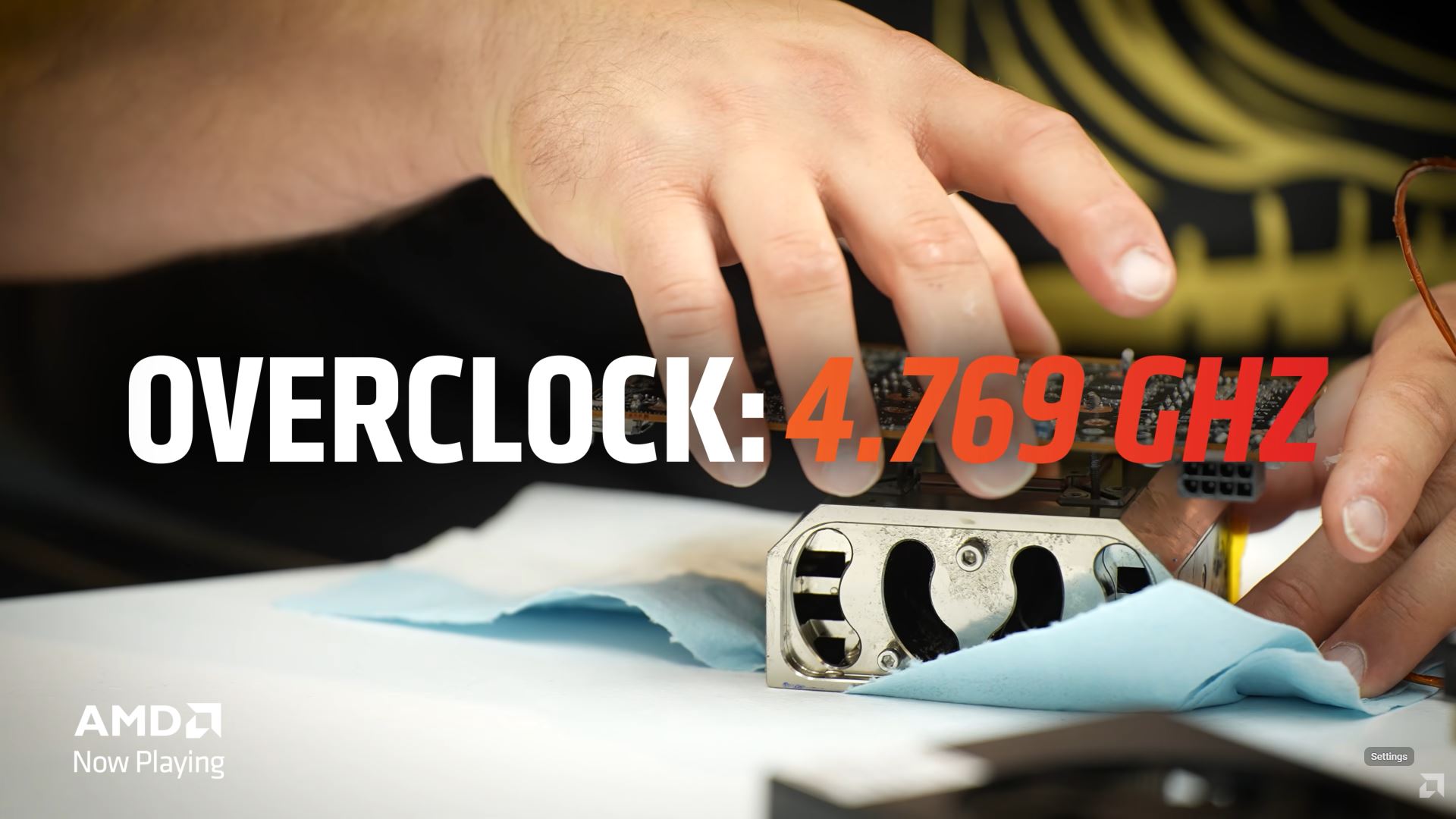
AMD has just redefined what’s possible in GPU overclocking, smashing the previous record with its budget-friendly Radeon RX 9060 XT. In a collaboration with overclocking legend Splave, the GPU was pushed to a staggering 4.769 GHz—far beyond its official boost clock of 3.13 GHz—using liquid nitrogen cooling. This isn’t just a marginal improvement; it’s a near-1.6 GHz leap over the GPU’s reference performance and a record that dwarfs even the most aggressive overclocks seen on high-end GPUs like the GeForce RTX 4090.
The achievement underscores the extremes of hardware tuning, where enthusiasts and manufacturers test the physical limits of silicon. But how does this translate into real-world performance? And who might actually benefit from such extreme overclocks?
A Feat of Engineering—or a Niche Hobby?
The RX 9060 XT’s official boost clock sits at 3.13 GHz, and even with air or liquid cooling, most users can expect stable overclocks in the 3.3–3.5 GHz range. To reach 4.0 GHz, let alone 4.769 GHz, requires not just specialized cooling but also a willingness to accept instability and short-lived performance gains. Liquid nitrogen, while effective, is impractical for everyday use—making this record more of a milestone for enthusiasts than a practical upgrade path.
That said, the record demonstrates AMD’s RDNA 4 architecture can handle far more aggressive clock speeds than its stock settings suggest. For those already pushing their hardware to the limit, it’s a sign that there’s still untapped potential—though the tradeoffs in power, heat, and longevity remain significant.
Who Cares About 4.769 GHz?
The RX 9060 XT is a mid-range GPU, typically aimed at 1080p gaming or budget-conscious creators. For most users, the 3.13 GHz boost clock is more than enough to deliver smooth performance in modern titles. Overclocking to 4.769 GHz isn’t just unnecessary—it’s impractical for daily use. But for a small community of overclocking enthusiasts, this record is a testament to what’s achievable with the right tools and conditions.
Even then, the gains from such extreme overclocks are marginal. A 1.6 GHz increase might translate to a few extra frames per second in benchmarks, but the real story here is the engineering behind it. It shows that AMD’s architecture can handle far more stress than its default settings imply, which could influence future overclocking tools, cooling solutions, or even stock performance tuning.
The Bigger Picture: Overclocking as a Spectator Sport
Records like this one serve as a reminder that overclocking is less about real-world utility and more about pushing boundaries. The last time a discrete GPU crossed 4.0 GHz was with NVIDIA’s RTX 4090, and even that required extreme measures. AMD’s achievement isn’t just about the RX 9060 XT—it’s about proving that modern GPUs, even budget ones, can reach frequencies once reserved for high-end parts.
For the average user, this news might not change anything. But for those who follow hardware innovation closely, it’s a sign that the ceiling for GPU performance is still being raised—even if the floor remains firmly planted in practicality.
Key Specs: Radeon RX 9060 XT (Stock vs. Overclocked)
- Base Clock: 2.5 GHz (stock)
- Boost Clock: 3.13 GHz (stock) / 4.769 GHz (record)
- Cooling Required: Liquid nitrogen (for record), air/liquid for modest OC
- Target Audience: Enthusiasts, benchmarkers, extreme overclockers
- Real-World Impact: Minimal for most users; symbolic for hardware limits
The RX 9060 XT’s architecture allows for impressive overclocks, but the practical benefits remain limited. Most users will stick to modest tweaks—perhaps 3.3–3.5 GHz—where stability and longevity matter more than record-breaking speeds. The 4.769 GHz mark, while impressive, is a niche achievement, highlighting the gap between theoretical potential and everyday usability.
For now, this record stands as a testament to what’s possible—not what’s practical. And for AMD, it’s another data point in the ongoing arms race of GPU performance, even if the battle is being fought in the extreme corners of overclocking rather than mainstream adoption.